Grab ten different cups off ten different shelves and you'll know within seconds which ones were actually designed and which ones just happened. One settles into your hand like it's been there before. Another has you adjusting your grip mid sip, wondering why something this simple feels this awkward.
That gap has almost nothing to do with beauty. It's ergonomics, and it's the one thing nobody mentions when they're out shopping for a tea cup set.
Most of us buy with our eyes first. The glaze, the pattern, how the whole thing looks sitting next to the teapot. Fair enough, honestly, that's how most of us shop for anything. But the real experience of drinking tea starts long before the tea reaches your mouth. It starts the second your fingers find the handle and decide, almost instantly, whether this is going to be easy or not.
Good design just disappears at that point. You stop thinking about the ceramic tea cup and go back to whatever you were actually thinking about before you picked it up.
What "Ergonomic" Actually Means for a Tea Cup Set
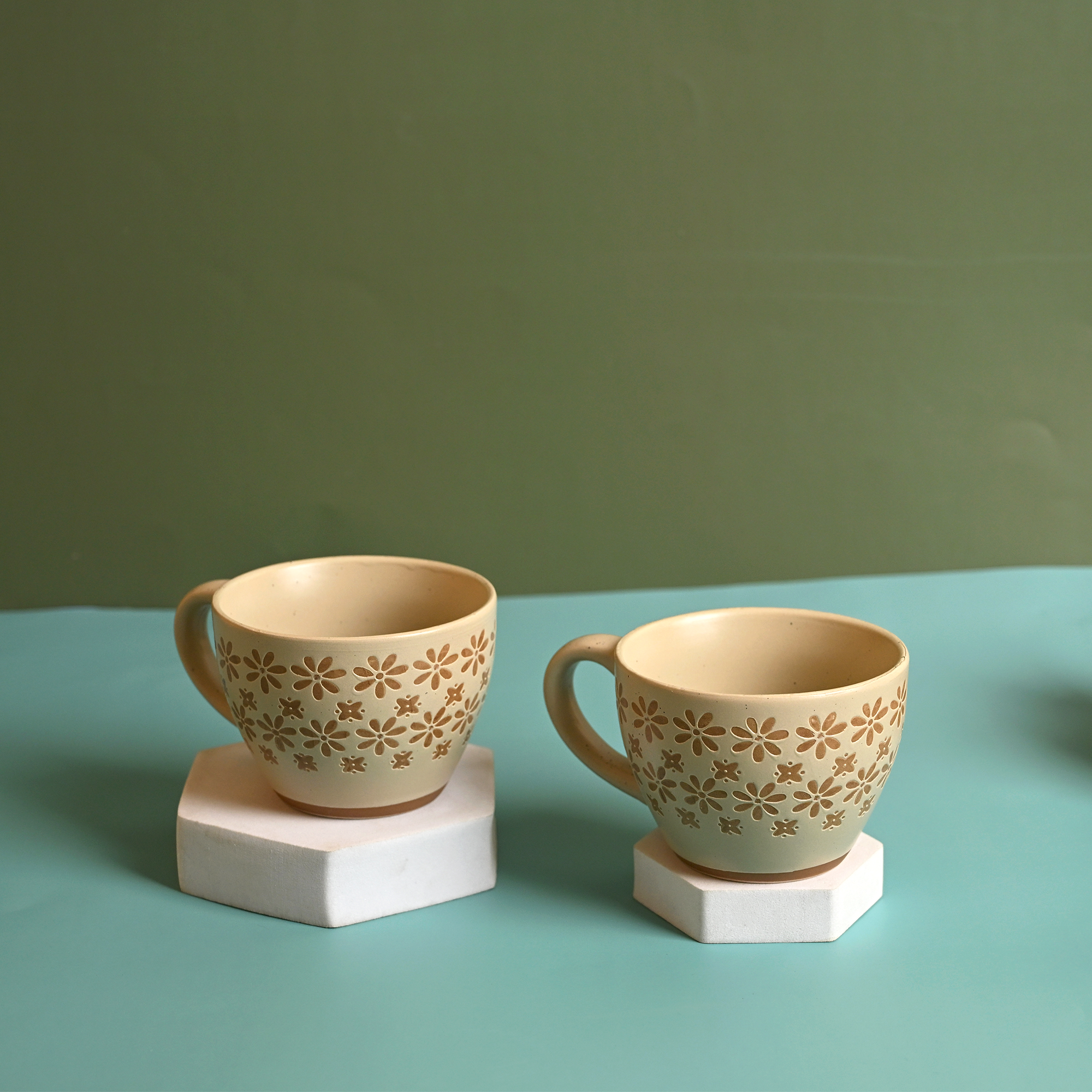
An ergonomic tea cup is built to work with your hand instead of asking your hand to do all the adjusting. Handle, rim, base, weight, material, all of it pulling in the same direction instead of fighting each other.
Nobody wants to be thinking about grip mechanics while pouring tea for their in-laws. That's kind of the whole point of good design. It does the thinking so you don't have to.
And tea is rarely just a drink. It's the first proper stretch of a slow morning. It's the drinkware set you keep refilling during a conversation that's gone on longer than planned. It's the one you make at eleven at night once the house has finally gone quiet. Something that shows up that often in your day stops being just an object. Comfort isn't a bonus feature anymore at that point. It's the whole job.
The Handle Should Just Make Sense

Watch someone use a badly designed cup saucer set sometime. There's a small pause, a half second where their fingers are testing two or three positions before landing on one that feels secure enough to actually lift.
That little hesitation tells you everything you need to know.
A handle that's too small pinches your fingers into an awkward curl. Too big and the whole cup feels loose, like you're not quite steering it. The perfect tea cup set sit right in between, enough room for two fingers without straining, a curve that feels obvious rather than clever.
Hold the tea cup before you buy it, if you can. Your hand should settle immediately. No searching, no second guessing, no negotiation.
Weight Isn't the Whole Story. Balance Is.
A lot of people assume lighter automatically means more comfortable. It doesn't.
What actually matters is where that weight sits. A cup saucer set with real heft can still feel effortless if the weight is spread evenly across body, handle, and base. Meanwhile a featherlight cup can feel strangely off if too much of its weight bunches up on one side.
You'll feel this most once there's actual tea in it. Lift an empty cup by all means, but picture, or better yet test, how it feels full. A good cup and saucer set stays steady whether it's empty or holding a full pour, not just when there's nothing inside to expose the imbalance.
Why Dimensions of Rim Matters in Tea Cup Set?

Nobody stands in a shop studying the rim of a tea cup set of 6 or ceramic cups. It's easy to overlook. It's also the first thing you physically feel the moment tea actually reaches your lips.
A well finished rim is smooth, not sharp, not clunky, shaped so tea flows out at a pace that feels natural rather than rushed or dribbly. This is where craftsmanship stops being something you look at and becomes something you can only judge by using it.
A tea cup set can look stunning from across the room. The real test happens the second it meets your mouth, and that's exactly where the good tea cups quietly set themselves apart from the rest.
What is the Sign of Ergonomic of Tea Cup Set?
A cup exists to hold liquid, so judging it empty is kind of missing the point.
The body needs enough capacity for a decent pour without turning heavy and unwieldy the moment it's full. The base has to keep it grounded, not tippy. The whole shape should make lifting and drinking feel automatic instead of a small negotiation every time you reach for it.
This matters even more with a tea cup set of 6. Every cup has to behave exactly the same way. Nobody wants to be the one guest handed the wobbly cup while everyone else got the good ones. Good design repeats itself without fail across the whole set, or it isn't really good design.
What is Role of Saucer in Tea Cup?
People treat the saucer as an afterthought, decoration sitting under the real star of the show. That's underselling it.
A saucer gives the cup somewhere stable to rest between sips, and a genuinely well made cup saucer set treats the pairing as one design, not two pieces that happen to stack. The cup shouldn't feel wedged in, and it definitely shouldn't feel loose. The saucer needs enough room for the cup to sit naturally while still being easy to carry across a room without disaster.
There's a visual payoff too. The saucer frames the cup, which gives the whole setting a sense of order instead of clutter.
Is Material Selection Important While Choosing Drinkware Sets?

Looks aside, material decides a huge part of what tea actually feels like to drink.
Ceramic has a reassuring heft people gravitate toward without always knowing why. But ceramic isn't one thing. There's real range inside that category, and the difference is obvious the moment you hold two cups side by side.
Ash free bone china has caught on for exactly this reason. It gives you that delicate, almost see through look people associate with classic bone china, minus the animal bone ash in the actual formula. What you end up with usually feels remarkably light in hand while still holding heat the way a good tea cup should.
None of this is purely cosmetic. Material decides how warm the cup feels against your fingers, how it holds up through years of daily washing, and honestly, how much you look forward to using it every single day.
How to Actually Pick an Ergonomic Cup Saucer Set?
Forget the pattern for a minute and run through a few practical questions instead.
Does the handle let your fingers sit naturally, no pinching, no stretching? Does the cup feel steady the second you lift it? Is the weight still manageable once it's actually full? Does the rim feel smooth rather than sharp against your lips? Does the cup sit securely on its saucer without wobbling around? Is the material right for how often you'll realistically use it? Does the size match what you actually pour? And, maybe most important, does it feel as good in your hand as it looks sitting on the table?
If most of those land on yes, you've found something better than a pretty cup. You've found one that someone actually designed with a real person in mind, not just a display shelf. Also, such tea cup sets also add cheery to the cake when you are looking for unique gifts for someone you love.
Final Note
Part of what makes tea so satisfying is how little it actually asks of you. Hot water, tea leaves, a familiar cup, a few minutes that belong entirely to you.
There's no real need to overcomplicate any of that.
That's why the best tea ware tends to feel quietly considered rather than loud or overdesigned. Every curve and proportion earns its spot, even when its only job is making a small daily habit a little more enjoyable than it strictly needs to be.
A good cup and saucer set doesn't need to be admired from a distance before it earns its keep. It just needs to be picked up, used, and picked up again, until it stops feeling like an object and starts feeling like a habit.
Explore thoughtfully designed cups and mugs at Kairaus, where everyday pieces are made to be lived with, not just looked at.
Sometimes the gap between an ordinary cup and a genuinely great one has nothing to do with what you see. It's what you feel the second you actually pick it up.
Frequently Asked Questions
What makes a tea cup ergonomic?
An ergonomic tea cup combines a comfortable handle, balanced weight, a stable base, the right capacity, a smooth rim, and proportions that all work together. Each part affects how easy the cup is to hold, lift, and drink from without having to think about it.
Does the material of a tea cup affect comfort?
Quite a bit, actually. Ash free bone china, for instance, tends to feel light and delicate while still handling warmth well, which is a big part of why it's used so often in elegant tea ware.
What is ash free bone china?
It's a version of bone china made without animal bone ash. Depending on how it's manufactured, it can still offer that fine, almost translucent look associated with traditional bone china, just without that particular ingredient.
Is a tea cup set of 6 practical for everyday use?
It works especially well if you host often or treat tea as something you share with people. It also keeps things consistent at the table, since every guest gets a cup and saucer that match in feel as well as looks.
Where can we find Pinteresty tea cup sets?
You can find Pinteresty as well as timeless tea cup set at Kairaus, a brand that serves luxury drinkware sets in sustainable limits and under artisanal supervision.